How to Turn User Research Into UX Design – The Four-Hour Design Sprint

Estimated reading time: 11 minutes
Key Takeaways
- Many product teams struggle to implement user research findings due to an activation problem, not a research problem.
- A four-hour design sprint compresses essential elements from the Google design sprint into an efficient workshop, enabling quick alignment and actionable outcomes.
- The session includes phases such as framing the challenge, lightning demos, individual sketching, and converging on a single concept.
- Participants leave with a shared problem statement, a sketched concept, and clear requirements, ensuring alignment and focus moving forward.
- Preparation is crucial; solid insights help frame user-centric challenges, setting a strong foundation for the sprint.
Turning Research into Design
“We’ve gathered and analysed the user research, but how the heck do we actually turn it all into action?”
That’s a statement I hear more often than not.
Most product teams don’t have a user research problem, they have an activation problem. Interviews are conducted, insights are documented, findings are shared in a slide deck and then the project moves forward without any of that work meaningfully changing the direction. The research sits in a folder, and the product gets built on instinct.
So the question is, what can be done to fix that?
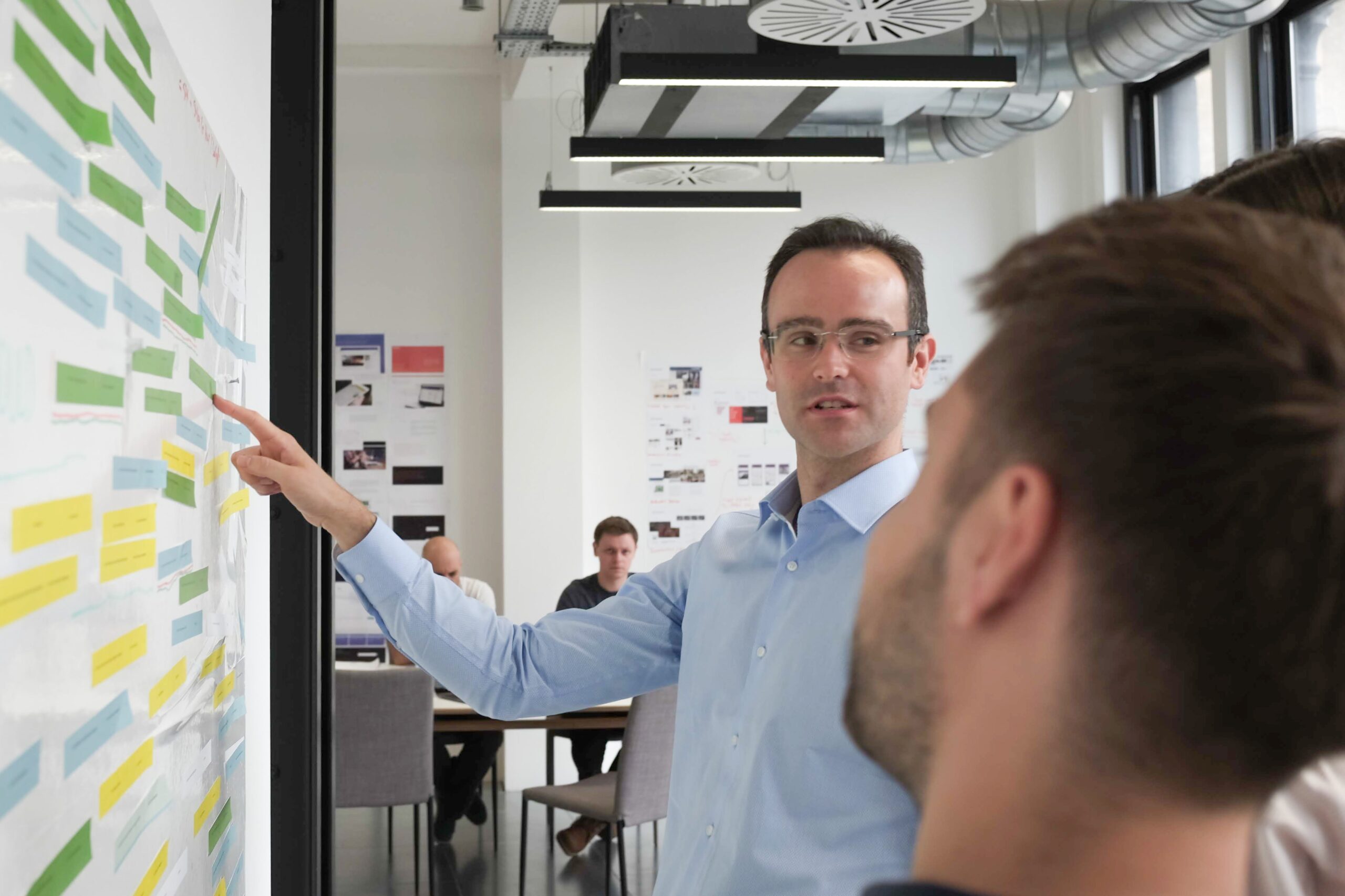
Well, we’ve started rolling out slightly new way of approaching the problem. We’ve taken the traditional design sprint and compressed it into a hyper focused four-hour workshop that closes that gap quickly, without the faff, without the costs, and at lightning speed.
Drawing on the core principles of Google’s five-day design sprint, it compresses the most valuable parts of that process into a single focused session: problem framing, external inspiration, individual ideation, and convergence on a single direction. At the end of four hours, a team has series of shared problem statements, researched examples, a sketched concept, and documented requirements. That is enough to move directly into wireframing (I’ll share more on our AI wireframing process next month).
What makes it work is not speed. It’s structure. The session creates conditions that most workshops don’t: a clear framing of the user problems before anyone proposes solutions, individual thinking before group influence, and a convergence process that produces alignment rather than compromise.
Why Four Hours?
The original Google Design Sprint runs across five days and typically comes with a significant organisational commitment and a hard to swallow cost. For many teams, particularly those working in early discovery or on a single feature rather than a full product, that level of investment isn’t available or necessary.
The four hour format preserves the structural logic of the sprint while removing the phases that require more time than a single session allows: user testing, prototype building, and multi-day reflection. What remains is the part of the sprint that produces the most leverage, which is the alignment work that happens before a single pixel is placed.
The constraint also creates focus, participants know the session is bounded. There is no scope for tangents or extended debate. The time limit is part of the methodology, and it’s that level of hyper focus that allows it to work so well.
Here’s how we do it:
Phase 1: Frame the Challenge
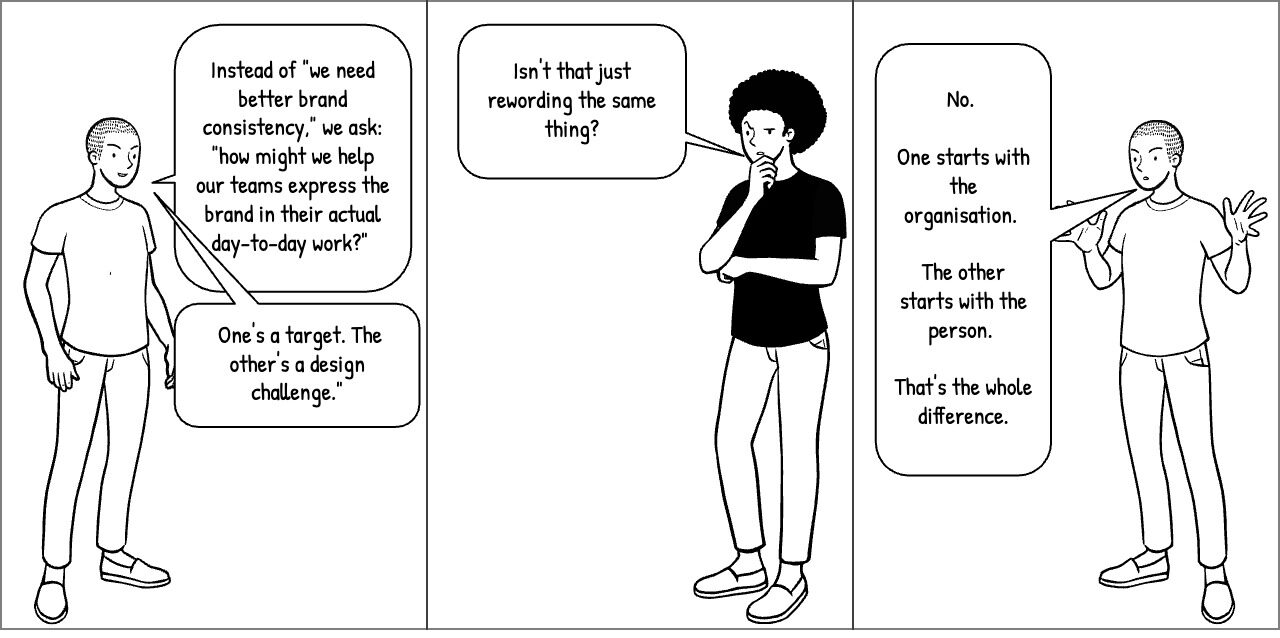
Before anyone discusses solutions, the group establishes a shared understanding of the problem. The central tool here are the How Might We statements, a deliberate reframing of internal requirements into user-centred challenges.
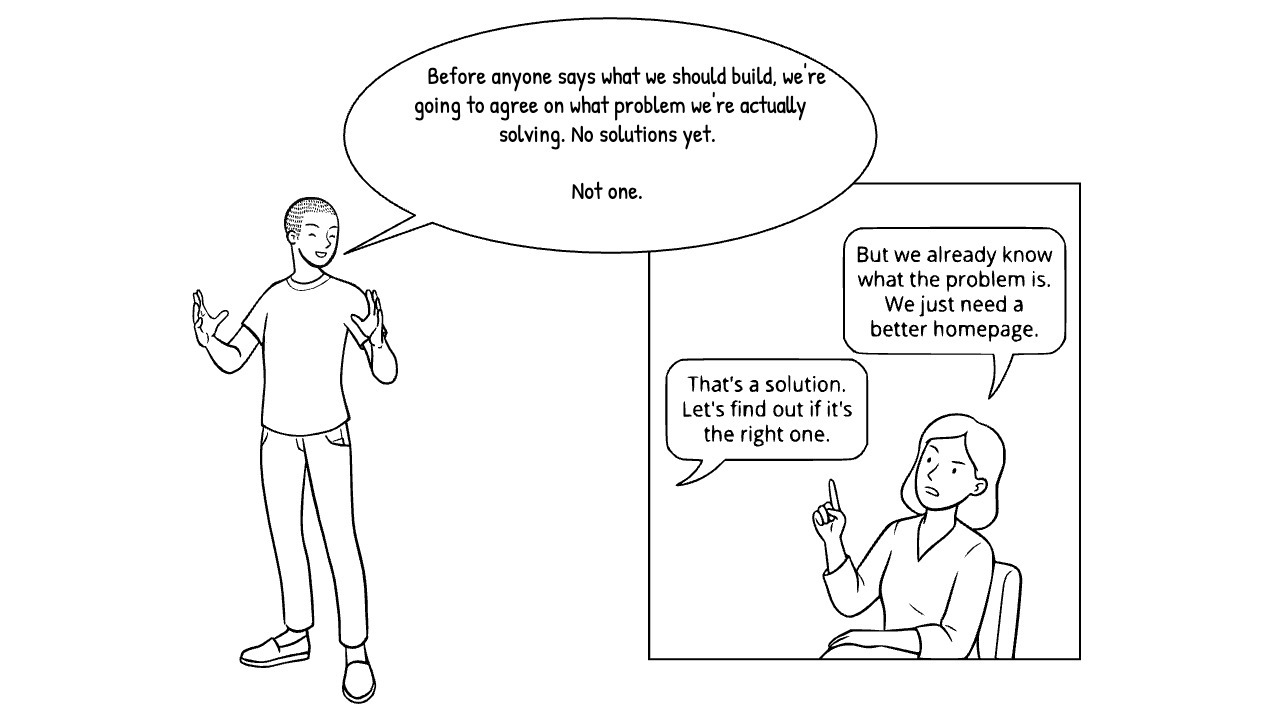
Internal framing describes what an organisation needs, now that’s useful as an objective, but it’s not a design challenge. A How Might We statement opens the problem up: it describes a user experience rather than an internal metric, and forces the team to think about real human friction rather than system requirements.
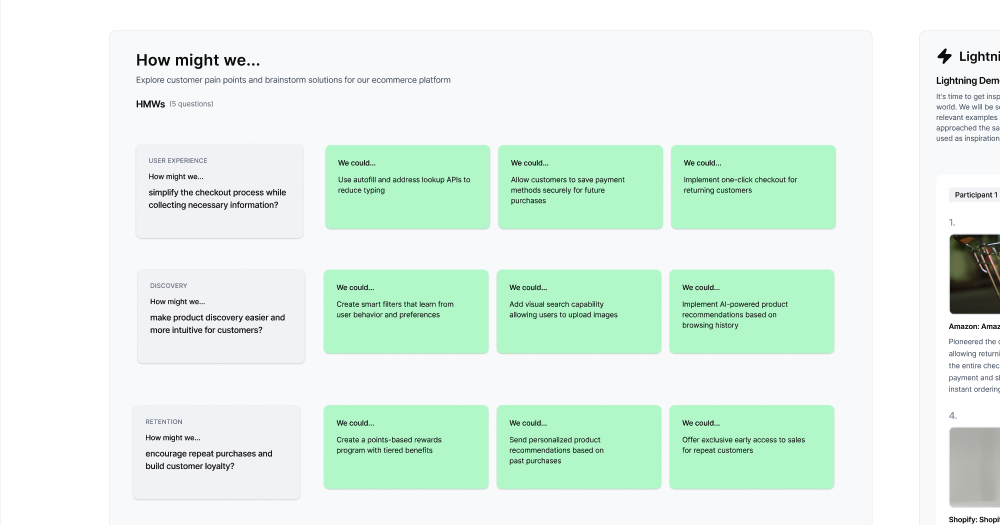
These statements are prepared before the workshop, grounded in interview data, behavioural analytics, or observed pain points. During the session, participants provide statements on how the challenges can be approached in a solution statement, then categorise them, and vote on the most important ones. Within minutes, the group has a prioritised set of challenges and potential solutions and critically, everyone is solving the same problem.
An example might be; ‘How Might We: Encourage customers to review their order before purchase‘, possible solution statements might be; ‘We could use AI auto-prompts based on order anomalies to ask; “You’ve selected different sizes across items, is that intentional?”, or ‘We could show notifications where we/AI think they’ve made an error on the order based on a typical order’.
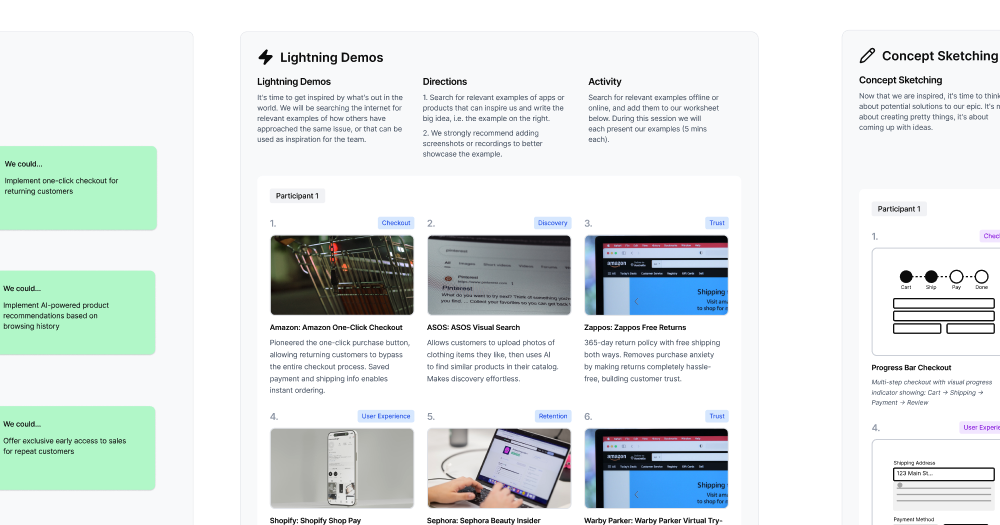
Phase 2: Lightning Demos
Before any sketching begins, the group looks outward to the web for inspiration. Each participant brings a handful of references: websites, digital products, interfaces, or experiences they believe are relevant, they need to be examples of where similar problems have been solved. These don’t have to come from the same sector. Some of the most generative inspiration comes from entirely different industries.
The goal is not to borrow ideas, moreover it’s to understand why something works, and whether that principle applies to the problem at hand. The right question is not whether you can use a reference directly. It is what that reference teaches you about your challenge.
Lightning demos prime the room with a shared reference base and expand the range of concepts that surface in the next phase.
Phase 3: Concept Sketching
This is the quiet part of the session where everyone works alone: no discussion, no collaboration, just focused thinking and sketching. Each participant sketches a potential concept or user journey based on the challenge defined in Phase 1 and the inspiration surfaced in Phase 2. The sketches don’t need to be polished, but they do need to communicate a solution within a user journey, accompanied brief notes explaining the thinking behind each step.
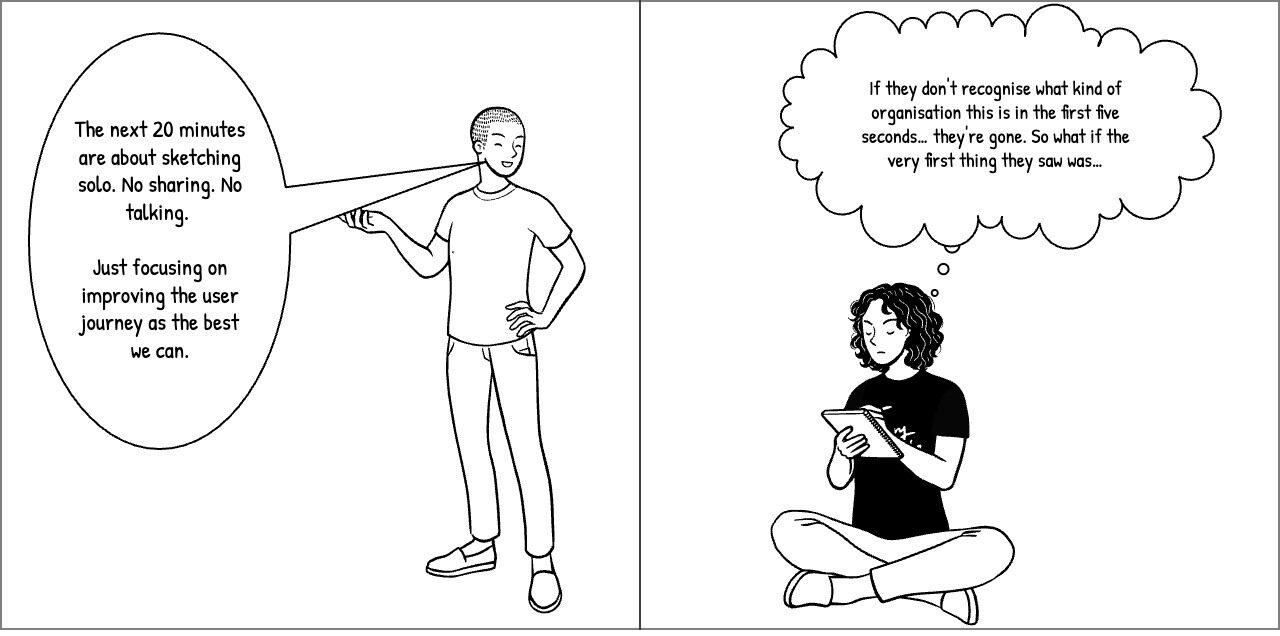
Individual ideation before group discussion is one of the most well-evidenced principles in design. It prevents the gravitational pull of the first idea raised, distributes contribution across the whole group, and produces a wider range of starting points than any brainstorm would.
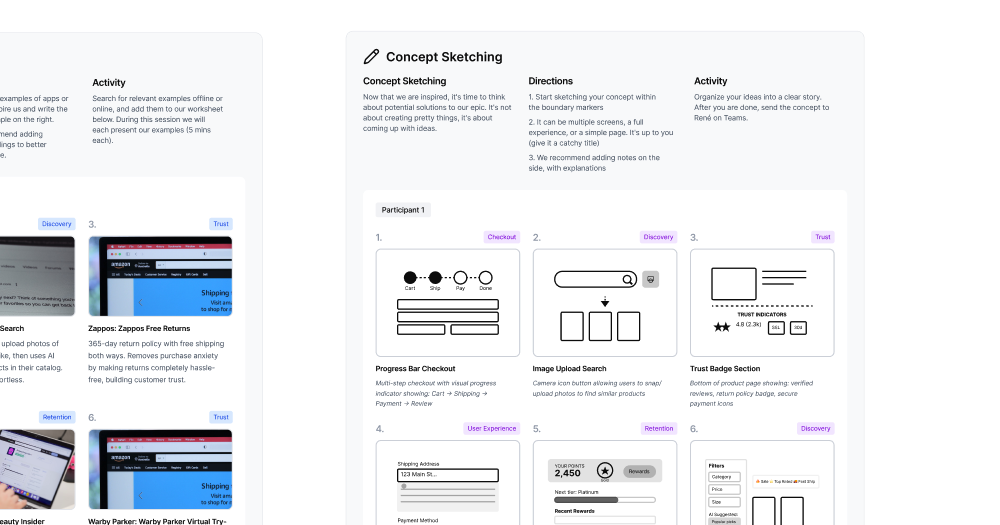
Importantly it also allows everyone the opportunity to silently vote on areas and ideas within each of the concept sketches that they think should be developed more – creating that all important collective ownership factor.
Phase 4: Converge on a Single Concept
Each participant presents their sketch, and the group identifies the strongest elements across all of them. The aim is not to pick a winner or reach a compromise. It is synthesis: combining the most effective ideas into one coherent direction that everyone has shaped and can support.
By the end of this phase, the team has a named concept, a defined user journey, and a set of documented requirements, assumptions, and edge cases. That is enough to move directly into wireframing.
In Practice: Connected Places Catapult
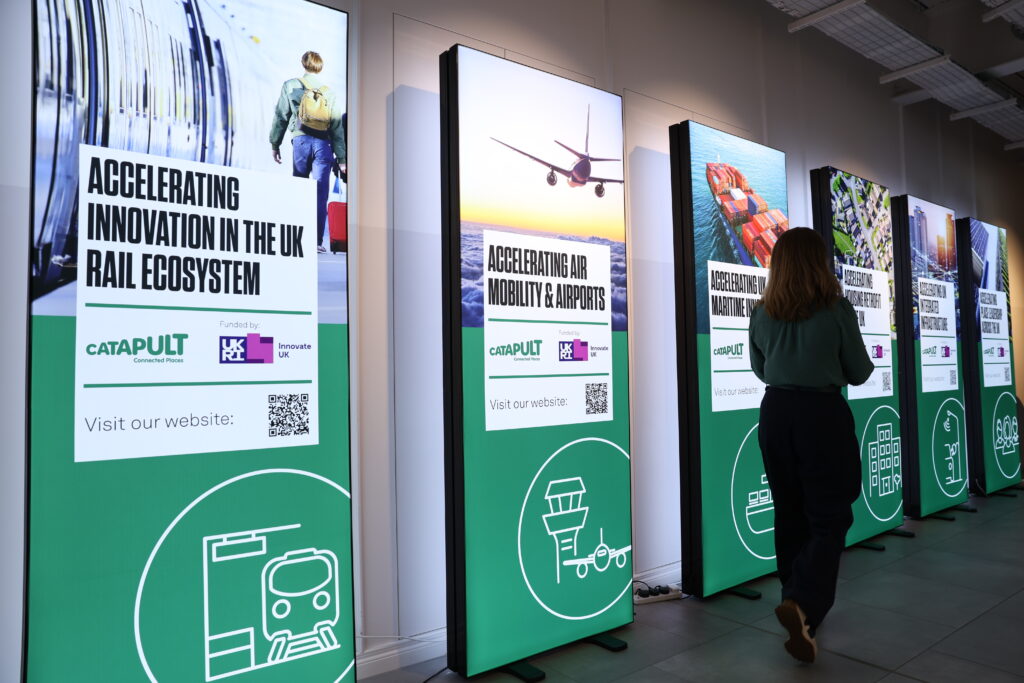
The brief was straightforward on paper: build a tool that helps city officials and stakeholders make better procurement decisions together. In practice, it meant bringing together representatives from multiple cities, government departments, and innovation programmes, each arriving with a different definition of the problem.
The sprint created conditions for alignment, How Might We statements drawn from prior research kept the conversation grounded in real friction rather than internal assumptions. Structured voting prevented the most senior voices from dominating; the priorities that surfaced reflected the group, not the hierarchy.
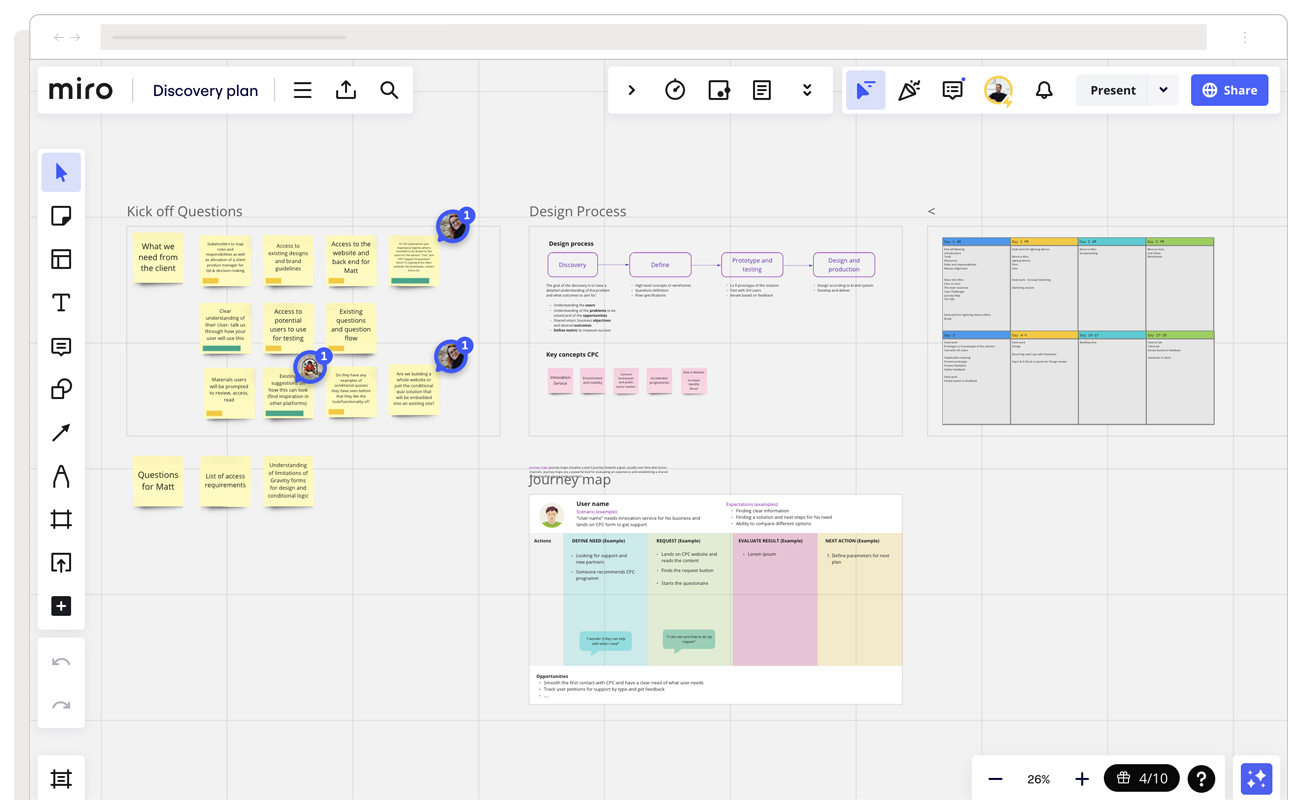
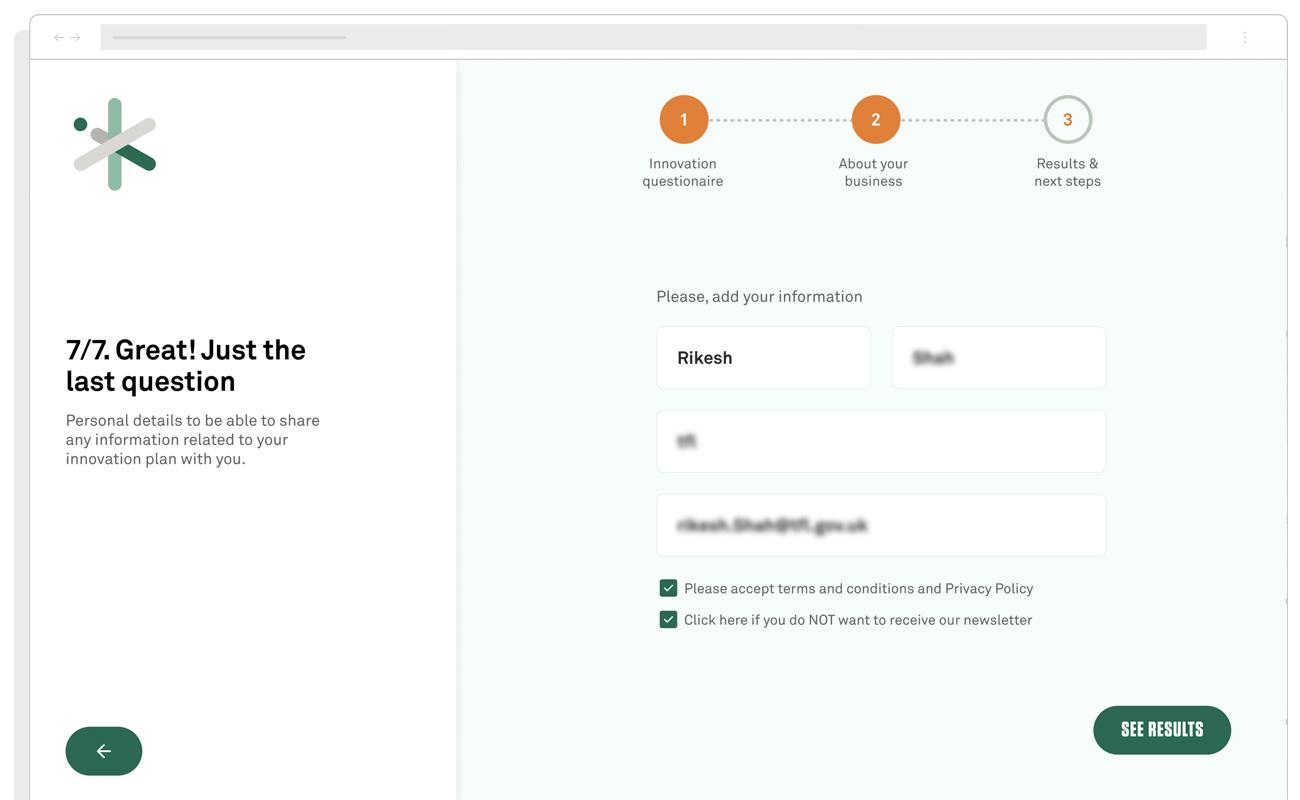
By the end of the session, all parties had shaped and agreed on shared user journeys. Those journeys became the blueprint for the finished product, a React-based platform connecting cities around shared procurement priorities. The simplicity of that tool was not a late-stage design decision. It was a direct consequence of the alignment work done at the start.
What You Walk Away With
A well-run four-hour sprint produces four tangible outputs: a shared problem statement framed from the user’s perspective; a single sketched concept the whole team has contributed to and agreed on; documented requirements, assumptions, and edge cases ready for the next phase; and genuine alignment rather than a meeting where everyone nodded and left with different interpretations.
That last output is the hardest to manufacture by any other means. It is also the one that pays dividends furthest downstream: in fewer revision cycles, in cleaner handoffs, and in products that hold together because the people who built them agreed on what they were building from the start.
A Note on Preparation
The sprint works best when the How Might We statements are grounded in real research, synthesised from interviews, analytics, or observed behaviour rather than assumptions. A 30-minute pre-call with key participants is often enough to surface the most important tensions and ensure the session starts on solid ground.
If you are running a sprint without prior research, it is worth considering whether the inputs are solid enough before committing to the format. The session amplifies clarity, but it can also amplify misalignment if the framing has not been properly prepared.
Frequently Asked Questions
What is a design sprint and how is it different from a four-hour design sprint?
A design sprint is a structured five-day process developed at Google for validating ideas through prototyping and user testing. A four-hour design sprint compresses the most essential elements, which are problem framing, inspiration, ideation, and convergence, into a single four-hour session. It is best suited to teams that need alignment and a clear direction quickly, without the commitment of a full week.
How many participants should be in a four-hour design sprint?
Four to seven participants is the ideal range. Fewer than four can limit the diversity of ideas in the sketching phase; more than seven makes convergence difficult to facilitate effectively. If you have a larger stakeholder group, consider running the sprint with a core team and presenting outputs to the wider group afterwards.
Do you need a professional facilitator to run a design sprint?
Not necessarily, but a designated facilitator, someone whose role in the session is to manage process rather than contribute content, makes a significant difference. The facilitator keeps time, manages the voting process, and ensures that all voices are heard during convergence. If you are running the sprint yourself, build in extra time between phases for reflection.
What research do you need before running a four-hour design sprint?
At minimum, you need enough user insight to write credible How Might We statements, challenges grounded in real friction rather than internal assumptions. This could come from user interviews, support tickets, analytics data, or field observations. A 30-minute synthesis session before the sprint, or a pre-call with participants to surface key tensions, is usually sufficient preparation.
What happens after the four-hour design sprint?
The sprint outputs, which are a shared problem statement, a sketched concept, and documented requirements, are enough to move directly into wireframing or low-fidelity prototyping. There are plenty of options for doing this, we’ve found low-fi wireframing using tools such a Figma Make, Relume, Claude or Gpt can work well to get things off the ground really quick (just don’t reply of the accuracy). From there, the natural next step is a round of user testing to validate the concept before committing to detailed design and build.
Can a four-hour design sprint work remotely?
Yes. Remote sprints require more structure around the sketching phase: participants need a shared digital canvas such as Miro or FigJam, and timers need to be visible to everyone. Dot voting works well asynchronously if participants are in different time zones. The convergence discussion is the phase most sensitive to remote delivery, so it is worth scheduling this during overlapping working hours where possible.
How does a design sprint relate to agile or scrum?
A four-hour design sprint sits upstream of agile delivery. It is a discovery and alignment tool rather than a delivery framework. Sprint outputs feed directly into the backlog: the sketched concept informs epics and user stories, and the documented requirements provide a basis for sprint planning. Running a four-hour design sprint at the start of a new feature cycle is a natural fit with most agile workflows.